Project Overview
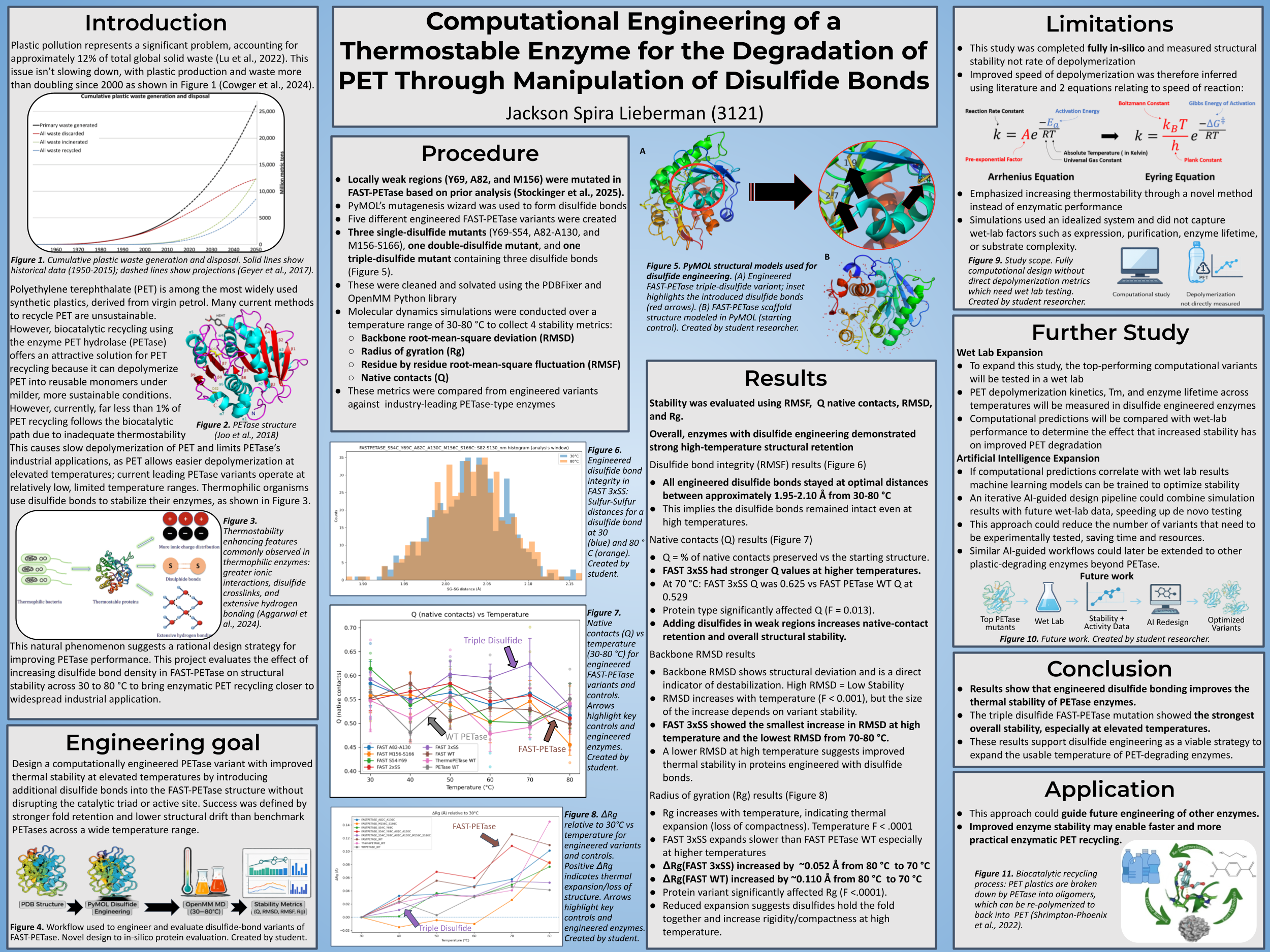
Plastic pollution accounts for ~12% of global solid waste, yet only ~10% of PET plastic is currently recycled. PETase enzymes offer a biocatalytic recycling pathway, but their poor thermostability limits industrial viability — wild-type PETase functions only between 30–40 °C, far below PET's glass transition temperature of ~75 °C. This study used computational protein design to engineer disulfide bonds into FAST-PETase, producing variants with significantly improved thermal stability validated through molecular dynamics simulations.
Methods
- Procured WT PETase, ThermoPETase, and FAST-PETase structures from the Protein Data Bank (PDB).
- Identified thermally weak residues (Y69, A82, V107, M156) from Stockinger et al. (2025) using PyMOL.
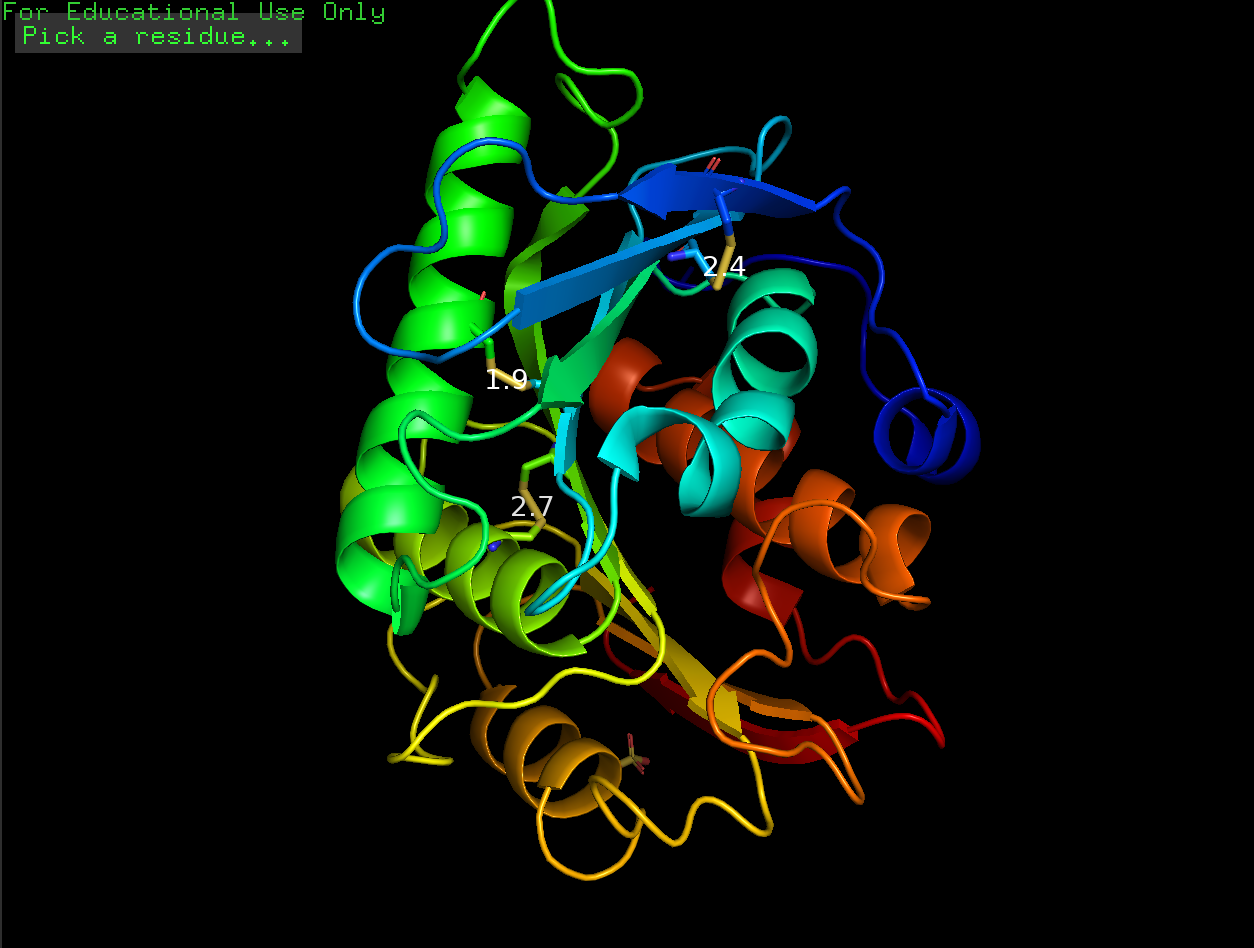
- Mutated candidate residue pairs to cystine using PyMOL's Mutagenesis Wizard to form engineered disulfide bonds.
- Validated 3D structure and confidence via AlphaFold (pLDDT scoring); discarded low-confidence variants.
- Ran molecular dynamics simulations (OpenMM + PDBFixer) at 30–80 °C in 10 °C increments, 3 replicates each.
- Measured thermostability via backbone RMSD, per-residue RMSF, radius of gyration (Rg), and native contacts (Q).
- Used two-way repeated-measures ANCOVA and linear regression to analyze results in JMP.
Key Results
- Triple Disulfide FAST-PETase achieved the highest mean Q (58.28%) vs. 53.36% for FAST-PETase WT.
- At 70 °C, Triple Disulfide Q (62.5%) was significantly higher than the next best enzyme (52.9%).
- Superior temperature window of 50–70 °C — the only variant to reach 70 °C as its peak stability range.
- Lowest mean backbone RMSD (0.0896) and smallest thermal expansion (ΔRg) across the temperature range.
- Engineered disulfide S–S distances remained centered near 2.0–2.05 Å at both 30 °C and 80 °C, confirming bond integrity.
- Protein variant had a significant effect on Q (F(7,94) = 2.7; p = 0.01) and Rg (F(7,94) = 5.7; p < .0001).
What I Learned
- Rational disulfide bond engineering at thermally weak regions can substantially improve enzyme thermostability.
- Native contacts (Q) is a more sensitive stability metric than RMSD for localized structural improvements.
- How to run and analyze molecular dynamics simulations using Python, OpenMM, and PDBFixer.
- How to design protein mutations in PyMOL and validate them with AlphaFold confidence scores.
- Statistical analysis of multi-condition biological simulation data using ANCOVA in JMP.
Tools & Technologies
- PyMOL — structural visualization and mutagenesis
- AlphaFold — 3D structure prediction and pLDDT confidence scoring
- OpenMM + PDBFixer — molecular dynamics simulations (Python)
- JMP — statistical analysis (ANCOVA, linear regression)
- Protein Data Bank (PDB) — source structures
Next Steps
- Wet-lab validation: clone, express, and purify top in silico variants.
- Measure PET depolymerization kinetics at elevated temperatures and compare against the FAST-PETase benchmark.
- Build a reinforcement learning agent to autonomously run MD simulations and optimize disulfide placement at scale.
Research Poster